Most small teams split money the same way: someone opens a spreadsheet the week before payday, adds up the store reports, and divides by a number everyone half remembers agreeing to. It works until the first refund, the first printing bill, or the first person who joined halfway through.
A fair split isn't a clever formula. It's a few decisions made in advance, written down, and applied the same way every month. Here are the ones that matter.
Decide what you're splitting
Before you talk about percentages, agree on the amount the percentages apply to. There are two common choices:
- Net: what's left after the store's cut and payment fees. This is what actually reaches your account, so it's the usual choice.
- Gross: the full sale price. Collaborators get their share of the sticker price, and whoever is on the other side of the split absorbs the fees.
Neither is wrong, but mixing them up is. A 40% share of gross is a lot more than 40% of net on a store that takes 30%.
Tip
If you're not sure, split on net. Everyone's share then moves with what the team really received.
Give the remainder a home
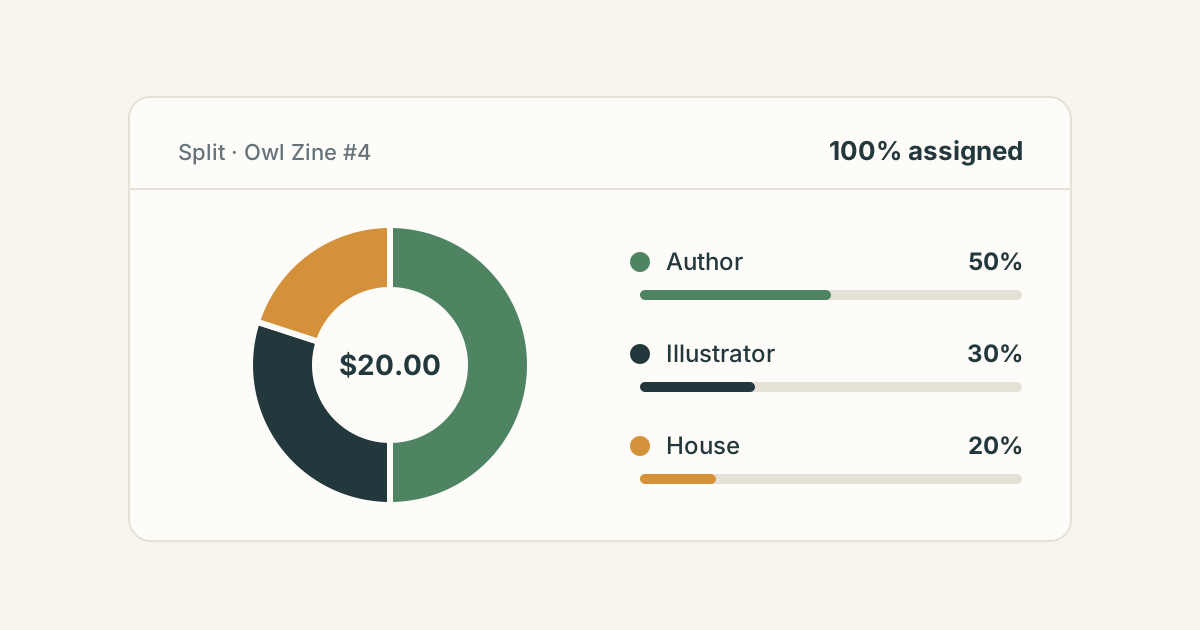
Write shares as percentages for the people who have agreed terms, and decide who gets whatever isn't assigned. In Splitfold that's the house: the workspace's own share. A press, label or studio usually keeps the house share to cover running costs.
Having a house matters more than it looks. Percentages rarely divide a sale into whole cents, so something has to absorb the leftover. Here's a $100.00 sale split 45 / 35 / 20:
| Collaborator | Share | Amount (USD) |
|---|---|---|
| Ana | 45% | 45.00 |
| Ben | 35% | 35.00 |
| House | 20% | 20.00 |
That one divides cleanly. Most sales don't. On $8.41 the exact shares are 3.7845, 2.9435 and 1.682, and the rounded amounts have to add up to $8.41 exactly, not $8.40 or $8.42. Splitfold uses largest-remainder rounding: everyone gets the whole cents they're owed, and each cent left over goes to whoever was closest to the next cent. When two people are tied, the house gets it first. Over a year that's a handful of cents, but it means every statement adds up to the money that came in.
Pay back costs before you split
If one person paid for the cover art, the print run or the ads, decide whether that money comes back to them before the split starts. That's what recoupable costs are for: they come off the top of the next sales, oldest first, and go back to whoever paid until they're covered. Then the split applies to the rest.
Recouping first keeps the split itself simple. Nobody has to argue about whether the illustrator's 30% should be "30% minus their part of the printing bill".
Write down the exceptions
Real agreements have edges. The common ones:
- Different terms per store. Bandcamp sales might split differently from itch.io. In Splitfold a rule can apply to one store only.
- Shares with an end date. A translator might get a share for two years. A rule can apply from or until a date.
- A better rate later. A writer might move from 40% to 60% once the costs are paid back, or after a number of units sold. Splitfold calls these steps.
If an exception isn't written down, it will be remembered differently by each person. Put it in the agreement and in the split.
Close the month and leave it closed
The last part of a fair split is that it doesn't change behind anyone's back. When a month is closed in Splitfold, its numbers are frozen and every collaborator gets a statement. If a sale was missing or a refund arrives later, it lands in the next open month and shows up on the next statement. Nobody's March changes in June.
That's also why every change to a split is recorded with what it was before and after. When someone asks "since when is my share 35%?", there's an answer.
A short checklist
Before your first payout, agree on:
- Net or gross.
- Each person's percentage, and who gets the remainder.
- Which costs are paid back first, and to whom.
- Any per-store rules, end dates or step-ups.
- When the month closes and when people get paid.
Then put it somewhere everyone can see it. If you use Splitfold, that's the project's Splits tab, and the splits and recouping guide covers each setting.