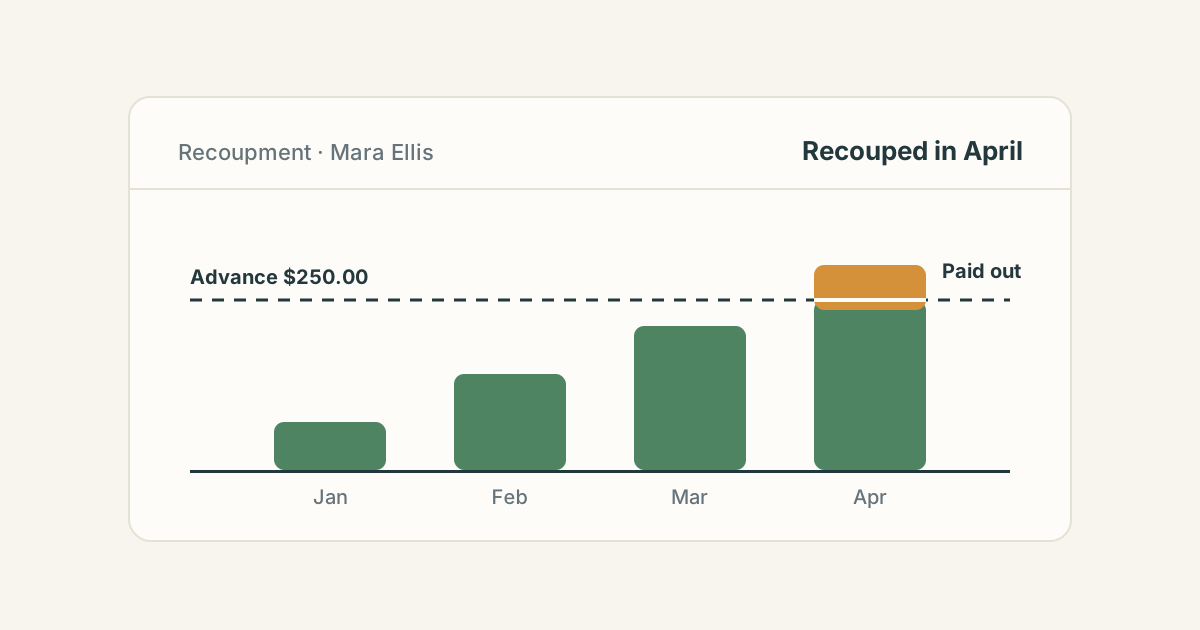
"Recoup" comes up in almost every publishing and label agreement, and it's often used for two different things: paying back an advance and paying back a cost. They work differently, and mixing them up is how statements end up wrong.
Two kinds of money paid up front
An advance is money paid to one person before sales come in. A press pays a writer $500 on signing; a label pays a band for studio time. It's that person's future earnings, paid early.
A recoupable cost is money spent on the project itself: cover art, printing, mastering, ads. It doesn't belong to any one collaborator's earnings. Whoever paid it gets it back before anyone shares in the sales.
The difference decides whose money pays it back:
- A cost is paid back from the whole sale, before the split.
- An advance is paid back from that one person's share, after the split. Nobody else's share is touched.
The order things happen in
For each sale, Splitfold works through the same steps:
- Costs come off the top. Recoupable costs are paid back oldest first, to whoever paid them, until they're covered.
- The rest is split. The project's shares apply to what's left.
- Advances come out of each share. If a collaborator has an advance outstanding, their share goes to whoever paid the advance until it's covered, oldest advance first.
- What's left is owed.
A cost or advance only counts against sales made on or after the date it was paid. A cost you add today doesn't reach back into last year.
A worked example
A small press publishes Mara's book. The project splits net sales 50/50 between Mara and the house, which is the press. Before launch, the press pays $300 for cover art, entered as a recoupable cost, and pays Mara a $500 advance.
Month one: $400.00 net sales.
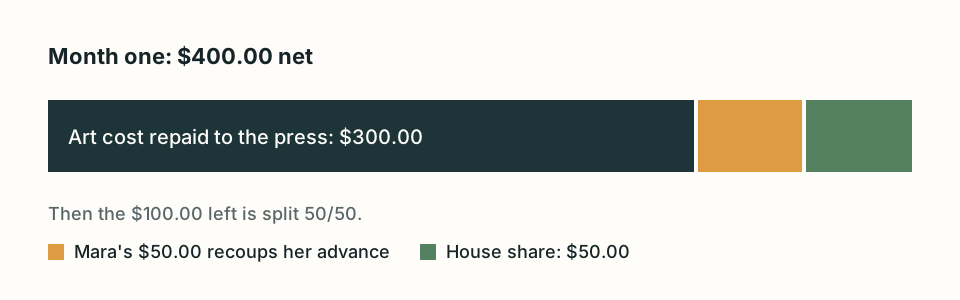
- The first $300.00 pays back the art. The cost is now covered.
- The remaining $100.00 is split: $50.00 to Mara, $50.00 to the house.
- Mara's $50.00 goes to the press against her advance. $450.00 of it is still to recoup.
Mara is owed $0.00 this month. Her statement still shows her $50.00 share, the $50.00 recouped, and the $450.00 still outstanding, so she can see the advance being paid down.
Month two: $1,000.00 net sales.
| Step | Mara (USD) | House (USD) |
|---|---|---|
| Split 50/50 | 500.00 | 500.00 |
| Advance recouped | −450.00 | +450.00 |
| Owed | 50.00 | 950.00 |
The advance is fully recouped. From the next sale on, Mara's whole share is owed to her.
Refunds
A refund reverses the sale it belongs to, recouping included. If a refunded sale had paid $5.00 towards Mara's advance, that $5.00 goes back onto the balance still to recoup. Nothing is lost and nothing is counted twice.
Closed months stay closed
Once a month is closed, what was recouped in it is part of the record. Editing or removing an advance later recalculates open months only. If an advance was entered wrong, the correction shows up in the next statement rather than rewriting one people have already been paid from.
Rates that change after recoup
Some agreements raise a collaborator's share once everything is paid back: "40% until the advance and costs are recouped, 60% after." In Splitfold that's a split step set to start after recoup. The sale that crosses the line still pays the old rate, and the new rate applies from the next one.
Things to agree before you pay an advance
- Is it an advance against this project only, or across several? In Splitfold, an advance is recouped from the collaborator's share on one project.
- Who paid it, and so who it's paid back to. Usually the house.
- Which costs are recoupable, and whether they come before or after the advance. In Splitfold, costs always come first.
- What happens if the project never earns it back. Most agreements say the advance isn't repaid out of pocket; it simply stays unrecouped.
The Advances and splits and recouping guides cover where each of these lives in Splitfold.